
Corrosion test
Corrosion test i.e. salt fog test is highly accelerated tests intended mostly for material or surface coating corrosion resistance characterization purposes.
Accredited corrosion testing – salt spray chamber tests and climate simulation
Corrosion testing is a laboratory method used to assess the resistance of materials and surface treatments to the stress caused by moisture, salt and climate conditions.
Corrosion is one of the most common causes of premature product failure. Without tested data, the effects of corrosion are often only detected in the field, which significantly increases repair costs and recalls.
Ensure the corrosion resistance of materials and products before series production and market entry. Toptester’s accredited corrosion testing simulates the stresses of moisture, salt and climate conditions in laboratory conditions. The testing produces measured data on the durability of materials, surface treatments and structures, allowing the right material choices to be made already during the product development phase.
What is measured in corrosion testing?
Toptester carries out corrosion testing in accredited laboratory conditions, simulating real-world environments. Testing can be used to assess the durability of materials, surface treatments and assembly solutions already in the product development phase before series production.
Corrosion testing produces measured data that can be used to make the right material choices before the product is brought to market. Often, testing is the only reliable way to ensure how the product or its components will withstand corrosive environmental conditions in the long term.
Corrosion testing can, for example,:
- Evaluate the long-term durability of materials and coatings
- Identify the risks of galvanic corrosion
- Compare the performance of surface treatment solutions
- Predict service life in different environments
Corrosion testing helps to make technically correct solutions before scaling up production.
For whom is corrosion testing most critical?
Test data enables the optimization of materials and surface treatments before the product is brought to market. Corrosion testing is particularly important for products that must withstand salt, moisture, chemical contaminants or variable climate conditions. Testing is widely used in industries such as industry, automotive and aviation, medical devices and commercial products.
In many application environments, corrosion is caused by the combined effect of several factors. In coastal areas and maritime transport, salty air accelerates the corrosion of materials, and in vehicles, road salt constantly loads structures. Accelerated corrosion testing can predict the long-term durability of a product and identify risks before series production.
Under what conditions does corrosion occur – and why is it tested under accelerated conditions
In a real application environment, corrosion almost always occurs as a result of the combined effect of several factors. Moisture, salt, temperature fluctuations and impurities load materials simultaneously, which accelerates the occurrence of damage.
Since natural corrosion can develop over years, accelerated test methods are used in testing. This allows the long-term durability of a product to be predicted in a significantly shorter time and produces data that can be used for product development quickly.
The effects of corrosion often only become apparent during use – for example, as weakening of electrical connections or structural embrittlement – when repair costs are already significant.
Corrosion testing according to standards
Testing according to standards ensures that test results are comparable and internationally accepted. This is especially important for products that are sold to multiple markets or used in demanding environments.
Accredited testing provides the manufacturer with an impartial and documented proof of the product’s durability. This facilitates certification processes and strengthens the product’s marketability. Like other tests, the corrosion tests performed by Toptester are also based on standards. The typical standards used in corrosion testing are IEC 60068-2-11 and ASTM B117.
At Toptester, corrosion testing is carried out according to international standards so that test results are comparable, auditable and acceptable in different market areas.
STANDARDS
- IEC 60068-2-52
- Nema 250 / ASTM B117
- Def(AUST)5681 section 7.6.1
- IEC 60068-2-11
- MIL-STD 810G, Method 509
- Customer´s own standard
Corrosion test methods – how to simulate real-world environments in the laboratory
Corrosion testing is based on simulating stress conditions that correspond to the environment in which the product is used. The test method is always selected based on the intended use of the product, the materials and the operating conditions.
In practice, corrosion testing is carried out in a simulated test environment, where various demanding conditions can be reproduced in a salt spray chamber. A basic salt spray test is typically carried out at a temperature of +35 °C using a 5% NaCl solution. In more demanding applications, cyclic tests, pH-modified tests or test programs simulating industrial environments can be used.
Often, the most realistic picture of the long-term durability of a product is obtained by combining several test methods in the same test program.
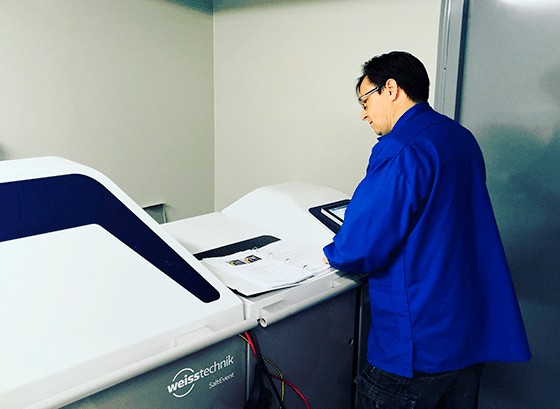
Test device: Weiss SC/KWT 1000
Test chamber volume: 1028 liters (1675 × 645 × 1140 mm, L × W × H)
Temperature range: 5 K above ambient up to +50 °C
Humidity range: from ambient to saturation point
Supported standards: e.g. DIN 50021, MIL-STD-810 Method 509, IEC 60068-2-11
Test process — how we work
Our test process is designed to produce reliable, repeatable data that can be directly used in product development.
Initial survey
- We define a test program based on the product and the operating environment.
Test program design
- We select standards, test durations and evaluation criteria.
Testing
- Carried out in an accredited laboratory, equipped with a salt chamber and environmental cabinets.
Evaluation and reporting
- We provide a detailed test report.
Follow-up
- If necessary, we repeat the tests after the modification or repair phase.
In practical test results, for example, coating cracks or peeling in the salt chamber often indicate an adhesion problem or inadequate pre-treatment. Similarly, rust spots or local corrosion can indicate material selection challenges or the need for additional protection. With the results of our test report, the durability of the product can be improved in a controlled and cost-effective manner.
Do you need corrosion testing for your product?
We help you determine the right testing strategy based on the intended use, materials and operating environment of your product. You will have the test results quickly available to support product development, certification and customer communication.
Corrosion testing is often combined with other environmental and reliability tests to get a realistic overall picture of the product’s behavior under real-world conditions. Corrosion testing can be combined with temperature and humidity testing or wind and rain testing, for example.
FAQ – Frequently Asked Questions about Corrosion Testing
What does a salt spray chamber test measure?
A salt spray chamber test evaluates the corrosion resistance of a material or surface treatment in a salty, corrosion-promoting environment.
How is corrosion testing performed?
Corrosion testing is performed by simulating environmental factors such as salt spray, humidity, temperature fluctuations and chemical stresses that cause corrosion in materials under real-world conditions in a laboratory.
Why is corrosion testing important?
Corrosion testing helps identify weaknesses in materials and surface treatments before products are brought to market. This reduces complaints, extends product life and improves product reliability.
How long does corrosion testing take?
The duration of the test depends on the test program and the standard being tested. Tests can last from hours to several weeks.
Can testing be customized for a specific product?
Yes. The test program can be designed to match the actual operating environment of the product and the customer’s requirements.
What happens if a product fails a corrosion test?
The test report helps identify the root causes of corrosion. The results can be used to optimize materials, surface treatments or structure.
Is corrosion testing required for all products?
Corrosion testing is especially important for products that are exposed to moisture, salt, chemicals or to adverse weather conditions.
Do you provide reports that meet regulatory requirements?
Yes. We provide documented, official test reports. The reports are used as is in the product approval process.
What samples do you need?
We need the part or component to be tested, as well as information about the operating conditions and desired evaluation criteria. The number of samples and preparation are determined during the quotation phase.