

Package test
Toptester is an ISTA-certified test house for package testing. We perform tests according to the ISTA standard or your own standard.
Packaging Testing – ISTA Certified Packaging Testing and Transport Validation
Packaging testing ensures that the product remains intact throughout the entire transport chain from the warehouse to the customer. Even a single transport damage can cause significant costs, delivery delays and reputational damage. Accredited packaging testing ensures that the packaging protects the product as designed under real transport conditions.
By outsourcing packaging testing to Toptester, you get documented and internationally accepted test results quickly, typically within a few weeks, without investing in your own testing equipment. At the same time, testing supports product development, quality assurance and supply chain risk management.
Why is packaging testing a critical part of the reliability of a product’s supply chain
Do you know whether the packaging you have chosen protects the product sufficiently during transport? Does the packaging work for the product and its materials? Can the packaging withstand storage and storage conditions?
Significant resources are usually invested in product development to bring the product to market. At this stage, however, transportation and the functionality of the transport packaging may receive less attention. The task of the transport packaging is to ensure that the product remains intact throughout the supply chain. Even good product development or product testing will not be successful if the product is damaged in transit.
Packaging testing provides measured data on the actual performance of the packaging and helps to identify risk points before they appear in the field as complaints, warranty costs or delivery delays.
Packaging testing can:
- verify the protective ability of the packaging
- identify critical risk points in the transport chain
- optimize packaging materials and structure
- reduce transport damage and complaints
- support certifications and customer requirements
Simulation of real transport conditions in packaging testing
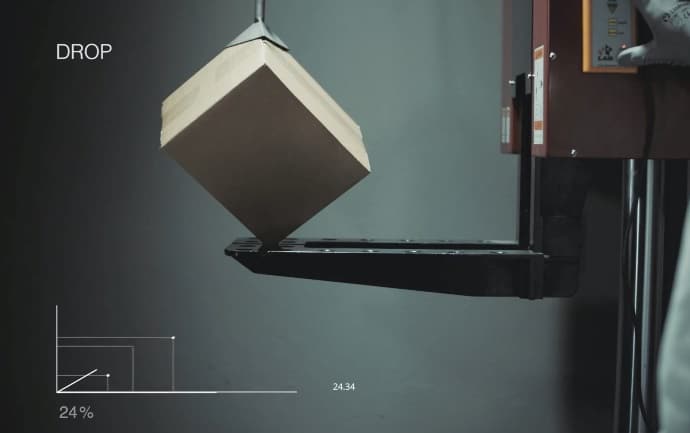
Toptester carries out packaging testing in accredited laboratory conditions using international standards and customer-specific test programs. We use, among other things, ISTA-certified test methods, which are the most commonly used method for testing transport packaging worldwide, and test protocols approved by logistics operators.
The testing simulates real transport chain stresses, such as shock, vibration, compression, temperature and humidity fluctuations, and loads during storage. These can be used to identify risk points in the packaging already during the product development phase, optimize the packaging structure, and minimize costs arising from transport damage.
Accredited ISTA packaging testing – Certified testing environment and expert service
ISTA-certified packaging tests can only be performed in a certified testing environment. Toptester is an accredited test house that meets the requirements set for ISTA testing.
ISTA packaging testing includes several different tests and test series. Toptester’s packaging testing service covers test design and customization, test coordination, and actual testing. We help you choose the right test from our test battery and tailor the test package to your requirements.
Packaging testing in accordance with standards enables reliable validation of supply chain performance and supports the international marketability of products. Documented test data supports both product development and customer and regulatory requirements.
You can read more about this test method here: ISTA Protocols.
STANDARDS – ISTA PACKAGING TESTING
The practical implementation of ISTA packaging testing is based on standardized test programs and test equipment that enable realistic simulation of transport stresses.
STANDARDS
- ISTA 1A, B, C, D, E, G, H
- ISTA 2A, B, C
- ISTA 3A, B, C
- ISTA 6 Amazon SIOC Type A, B, D
- ISTA 7D
- Customer´s own standard
Test equipment and test methods in packaging testing
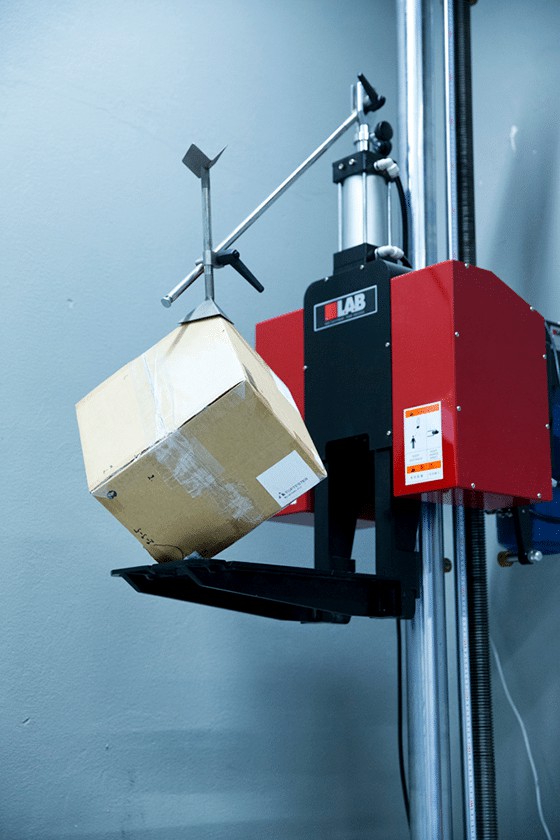
In the real supply chain, packaging is simultaneously exposed to multiple mechanical and environmental loads. ISTA packaging testing is carried out with various test equipment. We use environmental chambers, a shaker and a drop device in our service. All of our test equipment is calibrated regularly. The tests are carried out according to the ISTA standard or, if desired, according to the customer’s own standard.
Packaging testing usually consists of a combination of several test methods. In practical testing, a package may pass individual drop or crush tests, but the combined vibration and compression stress of transportation can reveal structural weaknesses. Without pre-testing, these weaknesses are often only discovered in the field, which can increase the repair costs many times over compared to changes made during the testing phase.
Drop tests
Simulate the package being dropped from various angles and heights during handling.
Transport vibration tests
Simulate the continuous vibration during transport. During transport, the package is exposed to continuous vibration and shock during road, sea and air transport, which stresses both the packaging structure and the product inside it.
Compression tests
Simulate the load caused by pallet stacking and storage.
Climate and environmental tests
Temperature and humidity fluctuations can weaken the mechanical properties of packaging materials and affect the level of protection of the product, especially during long storage periods. The combined effect of these stresses can cause damage to the product, even if the individual load does not exceed the critical limit.
Packaging testing as part of comprehensive reliability testing
Packaging testing is often part of a broader reliability and environmental testing package, where it is combined with, for example, vibration testing, temperature and humidity testing, IP and tightness testing, and wind and rain testing. By combining these test methods, a comprehensive overall picture of the behavior of the product and packaging in real operating, transportation and storage conditions can be formed.
FAQ – Frequently asked questions about packaging testing
What is measured by packaging testing?
Packaging testing evaluates the ability of the packaging to protect the product from mechanical and environmental stresses that arise during transportation, storage and handling, such as drops, vibration, compression and moisture.
Is packaging testing required for all products?
Especially important for products that:
- are transported over long distances
- are sensitive to shock or vibration
- are shipped internationally
- require validation according to standards
What is ISTA certification and why is it important?
ISTA (International Safe Transit Association) is an international organization whose protocols describe standardized test methods for different types of shipments. ISTA certification provides proof that the packaging has been tested and meets international requirements, which facilitates international trade and reduces risks.
Do you also offer customized test programs?
Yes. We create a test program based on the usage patterns of your product and the actual distribution chain.
How long does it take to receive a test report?
Smaller test programs and standard tests are often completed within a few days. Larger and customized programs typically take 1-2 weeks. The content and schedule of the report are always agreed in advance.
Will I receive an official test report and certificate?
Yes. We provide a comprehensive, documented test report with test results, photos, measurement data, analysis and recommendations. ISTA certificates are provided when the tests have been performed according to ISTA protocols and the customer is a member of the ISTA organization.
Which materials and packaging can be tested?
We test a wide range of materials and packaging: cardboard, plastic, wood, foam, composites and combined packaging solutions. Larger and heavier shipments are assessed on a case-by-case basis.
Can you test the durability of packaging for international transport?
Yes. We design the tests and protocols to match international transport and distribution chains, including multimodal transport (road, sea, rail, air).
How are the test results used in product development?
The test report contains concrete findings and correction suggestions for improving the packaging and filling materials. The report allows the design team to implement changes before production starts, reducing risks and costs.
What are the most common causes of packaging damage in the supply chain?
The most common root causes of packaging damage are related to a combination of multiple mechanical and environmental stresses during the entire transport chain. The most typical causes are:
- material fatigue caused by transport vibration
- deformation of the packaging structure caused by compressive stress
- effect of humidity and dryness on the mechanical properties of packaging materials
- microdamage caused by repeated handling steps
In many cases, a single stress does not exceed a critical limit. Instead, the combination of several stresses can cause damage to the product. Packaging testing can simulate these combined loads and identify risks before the products are exported to the market.
When is ISTA packaging testing alone not enough?
ISTA standards are the most widely used worldwide for testing transport packaging, but in some cases more extensive validation is required.
ISTA testing alone may not be sufficient, for example, when:
- the product is very large or heavy
- transportation takes place by multiple modes of transport (road, sea, air, rail)
- the products are exposed to unusual storage conditions
- the product is critical for industrial, safety or regulatory use
In these situations, packaging testing can be combined with, for example, environmental testing, vibration testing or other environmental testing. This provides a realistic picture of the durability of the packaging and product under real-world conditions.