

Drop test
Drop tests are for simulate the situation where the user drops the product accidentally. Drop angle and height varies on those situations.
Drop test – drop and impact testing to ensure product durability
A drop test tells you whether your product will last in the real world. Even one impact can be enough – and it often only happens at the customer’s. Test before the risk turns into a cost.
Drop testing is a key part of ensuring product reliability. It simulates the impacts and drops that products encounter during transportation, handling and use. Toptester carries out testing in accredited laboratory conditions in accordance with international standards, producing reliable test data to support product development and certification.
By outsourcing testing to Toptester, you get documented and internationally acceptable test results quickly, typically within a few weeks, without investing in your own testing equipment. At the same time, testing supports product development, quality assurance and product lifecycle risk management.
Why is drop testing a critical part of product reliability?
Do you know how your product reacts to a drop? Can the structure withstand a sudden impact? Will electronics function normally after a drop?
Product development often focuses on the functionality of the product, but mechanical durability is easily overlooked. In reality, products are constantly exposed to shocks and drops during transportation, installation and use.
Drop testing provides measured data on the actual durability of the product and helps identify weaknesses before they appear in the field as complaints, warranty costs or delivery interruptions.
Drop testing can:
- verify the impact resistance of the structure
- identify critical weaknesses and fracture points
- ensure the functionality of components and connections
- reduce defects and complaints in the field
- support product development and certification
Simulation of drop tests in real operating and transportation conditions
Toptester carries out drop tests in accredited laboratory conditions using international standards and customer-specific test programs. Testing simulates real stress situations, such as drops, impacts and sudden accelerations that products encounter, for example during transport or handling.
These can be used to identify risk points in a product already during the product development phase, optimize structure and material choices and minimize costs arising from damage.
Real-time measurement in drop testing – what happens and why?
Traditionally, drop testing has been able to determine when a product fails. Advanced measurement methods can also identify the cause of the failure. With Toptester, drop testing can be combined with real-time measurement, which simultaneously monitors resistance, elongation and acceleration.
This allows the exact moment when a failure begins to develop and the causes leading to it to be identified. This provides product development with significantly deeper information than simply examining the final result.
Drop testing in the laboratory – a reliable testing environment and expert service
Drop tests are carried out in accredited laboratory conditions, which ensures the reliability, repeatability and international acceptability of the test results.
Toptester offers a comprehensive service that covers:
- test design and customization
- test coordination
- actual testing
- analysis and reporting
We help you choose the right test methods and build a test suite based on the product’s intended use and requirements.
Standards – drop testing
STANDARDIS
The implementation of drop testing is based on international standards that enable the comparability of test results across different markets.
The most common standards are:
- MIL-STD-810 (Method 516 – Shock)
- IEC 60068 series
- ISTA standards (transport and packaging)
- customer’s own standard
Test equipment and test methods in drop testing
In a real-world environment, a product is rarely exposed to just one load. Instead, shocks, repeated drops and various mechanical stresses often act simultaneously. Drop testing uses test methods and equipment that can simulate these situations in a controlled and reproducible manner in laboratory conditions.
Testing can include free drops from different heights and angles, repeated drop cycles, and controlled impact and acceleration tests that allow the load to be precisely targeted at desired points in the structure. The choice of these methods is always based on the intended use of the product and the type of stresses it is expected to encounter.
A single drop is often not enough to assess the true durability of a product. Often, it is repeated impacts or a combination of multiple stresses that reveal weaknesses that are not visible in a single test, but can lead to failure in later use.
TEST EQUIPMENT
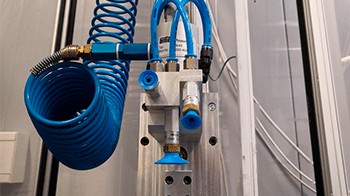
Nokia droptester NDT 2000 -24
- Suction cup grip and drop heights 1,2 meter and 1,5 meter
- Adjustable rotation speed and drop count
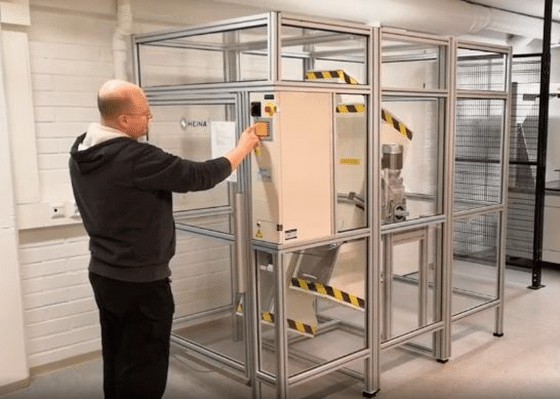
Heinä Tumble Tester
- Tumble test is used to test the breakage of various small items and components. The desired number of falls is selected. Tumble tester will drop the item onto the base of the machine at random positions (free fall).
Drop testing as part of comprehensive reliability testing
Drop testing is often part of a broader testing package, where it is combined with other reliability and environmental tests, such as vibration testing, temperature and humidity testing, IP and tightness testing, and packaging testing
By combining test methods, a comprehensive overall picture of the product’s behavior under real-world operating and transportation conditions is obtained.
Contact us for a quote
Ensure the durability of your product before testing it in the field. We can help you design a test that reflects real-world conditions.
FAQ – Frequently Asked Questions about Drop Testing
What does drop testing measure?
Drop testing assesses a product’s ability to withstand mechanical shocks and drops, as well as their effects on the structure and function.
Why is drop testing important?
It helps identify structural weaknesses and prevent failures in the field before the product is released to the market.
How long does testing take?
The duration of testing depends on the test program; typically from a few days to several weeks.
How is a drop test designed for a product?
A drop test is always designed for a product. The design takes into account the product’s intended use, transport chain, weight, structure, and any critical components. The test program can be based on international standards or tailored to meet real-world conditions.
What is the difference between a single drop test and repeated testing?
A single drop can reveal obvious structural weaknesses, but repeated drop testing often reveals material fatigue and cumulative damage. In many cases, a product can withstand a single impact, but fail after multiple impacts.
Can a product pass the test and still fail in use?
Yes. A single test method does not always reveal all risks. In a real-world environment, loads often occur simultaneously, such as vibration, temperature fluctuations and shocks. Therefore, drop testing is often combined with other test methods to get the full picture.
What are the benefits of real-time measurement in drop testing?
Real-time measurement enables a more accurate analysis of failure. It can be used to identify the moment when a failure begins to develop and the causes leading to it. This information is particularly valuable in product development, as it helps to target improvements correctly.
When should drop testing be performed in product development?
Drop testing should be performed as early as possible in product development. This allows structural weaknesses to be identified and corrected before mass production, reducing costs and accelerating time to market.
How is drop testing related to packaging testing?
Drop testing can be applied to either the product itself or the packaging. Packaging testing assesses whether the packaging protects the product from drops during transport. Combining these tests provides a comprehensive picture of the functionality of the product and packaging in the supply chain.
What standards are used in drop testing?
Drop testing can be carried out in accordance with several international standards, such as MIL-STD-810 (shock and drop tests), IEC 60068 series and ISTA standards for transport and packaging testing. In addition, testing can be tailored to the customer’s own requirements.
What types of defects are typically detected in drop testing?
Drop testing often detects structural fractures, failed connections, component detachment and malfunctions of electronics. In addition, latent defects that only become apparent during later use can be identified.
How quickly are the test results available?
The duration of the test depends on the scope of the test program, but the results are typically available within a few days or weeks. The test report includes the measurement results, analysis, and recommendations for further action.